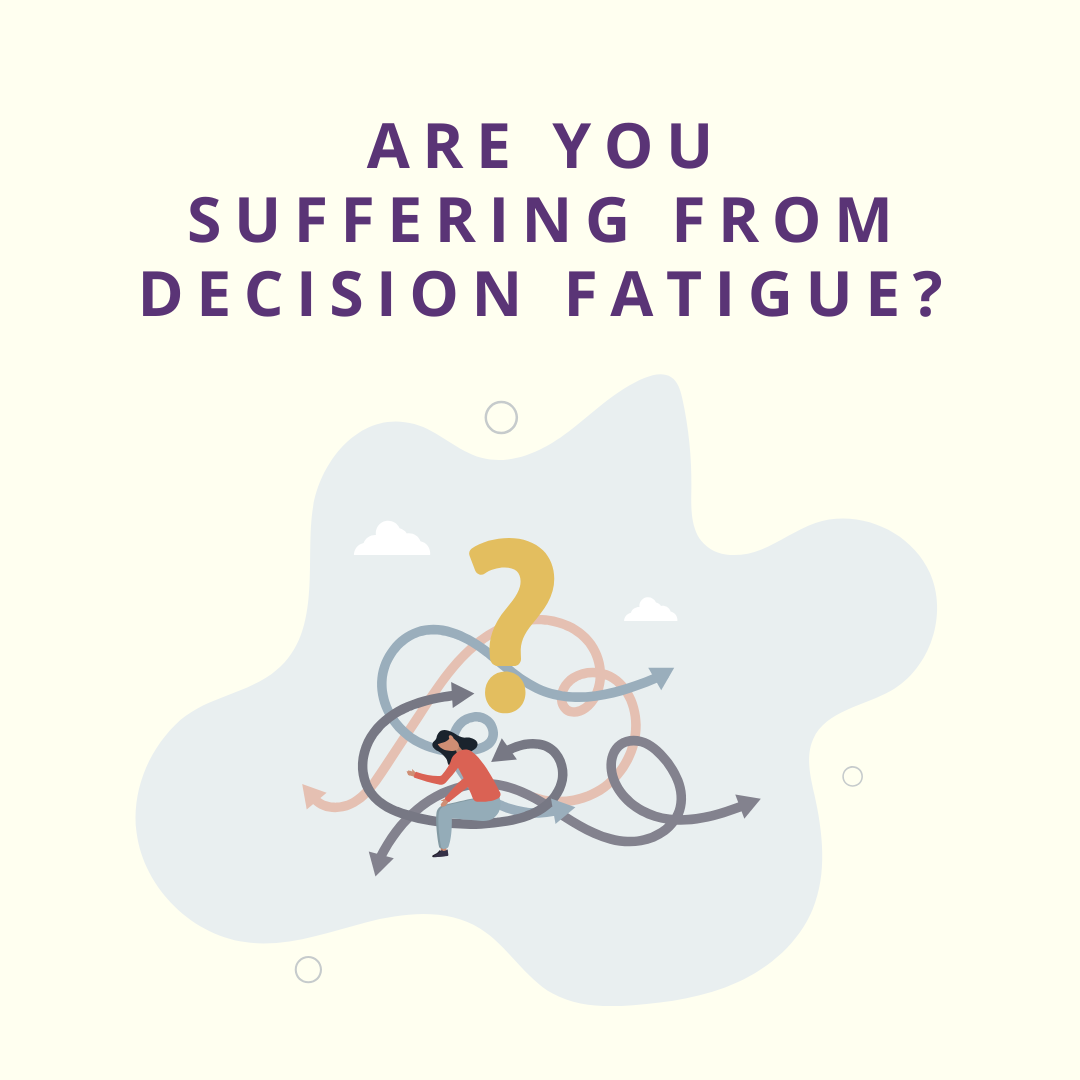
Are you suffering from decision fatigue?
It might be the result of choice overload.
Have you ever gone to a restaurant and the menu was so big that you had difficulty deciding what you wanted to eat?
That’s when you end up giving up, saying, “I’ll just have the burger!”
Have you had the experience of trying to purchase a new laptop and been overwhelmed by the options and the number of decisions you’ve had to make? Everything from what brand and model to how much RAM you need to screen size, weight, color, and more.
Have you ever given up on a purchase because the process was too complex or took too long?
If any of these examples resonate with you, you’ve experienced choice overload. When you have too many options, it can become overwhelming, and that can lead to stress, anxiety and mental fatigue.
You fall victim to decision paralysis, or what I like to call analysis paralysis. With too many available options, you end up not making any decision at all, either because you are overwhelmed or because you over-analyze for fear of making the wrong choice.
When you use up your decision-making ability on inconsequential decisions, you may not have the mental or cognitive capacity to make the more important decisions that have a greater impact on your work and your life.
There are several ways you can combat this problem, as you’ll see below.
Fighting Decision Fatigue: Prioritize
Decision fatigue is the condition that occurs when we get overwhelmed, stressed, and anxious as a result of having to make too many decisions. And that can lead to a failure to make any decision at all.
So how can we overcome this problem?
In his book, The Purpose Driven Life, Rick Warren says, “You become effective by being selective,” and “Never confuse activity with productivity.”
Productivity expert Daniel Pink’s number one productivity tip is DO LESS.
If you’re falling victim to decision fatigue, you need to make fewer decisions. To make fewer decisions, you have to limit what you undertake in the first place.
Focus on the most important and most essential aspects of your work, those that have:
(1) an important purpose and
(2) a high value outcome.
If the task has BOTH an important purpose and a high value result, make it a priority.
When determining priority, consider your core goals and values. Think about what will benefit your firm and your clients in the long term, what adds the most to your bottom line, and what requires your personal participation or expertise.
Choose only a limited number of priorities at one time; I recommend no more than three.
Reduce Your Options to Diminish Decision Fatigue
Prioritizing and focusing on your highest-value tasks and initiatives can help you to do less and to reduce decision fatigue, but what if one of those high-value tasks or priorities still involves too many choices?
Simplify the decision by reducing the number of options you choose from.
Here are five ways to do that:
- Limit your options by setting a budget. Decide in advance how much money you want to invest in that initiative. For example, if you are choosing new software for your practice, determine in advance how much you want to spend each month and limit your options to those that fit within your pre-determined budget.
- Set a deadline for making the decision. While at first glance this may seem to add to the stress of decision-making, setting a deadline can actually reduce stress. It forces you to make a decision and move on, instead of constantly re-evaluating or trying to explsore every single option that exists.
- Make a list of your must-haves. This is a bit like prioritizing, but on a more granular level. Determine what is non-negotiable. Using our software example, what features are the most important to you? What other programs must it integrate with? Eliminate any options that don’t include your must-haves.
- Eliminate options by category. This is a great way to reduce your options to make a choice easier when the category isn’t critical. A great example is our huge restaurant menu. Faced with an overwhelming number of options for dinner, you might decide to focus on just the chicken dishes, or only the soups and salads, to reduce your choices.
Another example of a category could be a brand; for example, when choosing new devices for your firm, you might decide to stick with only Apple products.
- Use social proof to help you choose. This is what we do when we filter out results on Amazon to only the items rated four stars and above. If you’re trying to choose between a large number of options, filter them out by those that have the highest rating and only choose among those options.
You can also do this by polling your colleagues who have made a similar decision in the past; ask which software programs other similarly-situated lawyers are using in their practices and if they like them; then only choose among the three most popular.
Reduce Decision Fatigue By Eliminating Inconsequential Decisions
In The Purpose Driven Life, Rick Warren says, “It is usually meaningless work, not overwork, that wears us down, saps our strength, and robs our joy.”
We’ve seen how prioritizing and limiting choices can reduce decision fatigue.
But what do we do with the decisions that don’t belong to our priorities, but that still need to be made?
We can call these decisions inconsequential decisions—decisions that don’t have a major impact on our goals, our clients, or our bottom line. Those decisions drain our energy, making it more difficult to make more important decisions.
The solution is to offload those less important decisions by delegating them or automating them.
For example, the number of decisions that need to be made every day with respect to email alone is enough to cause decision fatigue. But many of those decisions can be automated.
Rules and filters automatically sort and flag the most important messages so you don’t waste time wading through less important messages.
Scheduling specific times to review and respond to email instead of constantly checking your messages allows you to focus on more important work and strategic thinking.
Developing pre-written templates allows you to handle standard client communications or frequently asked questions without reinventing the wheel.
What inconsequential decisions can you automate to reduce your decision fatigue?
Automate Inconsequential Decisions to Reduce Decision Fatigue
Here are a few more examples of how you can automate those inconsequential decisions:
Calendar automation tools can schedule single appointments or recurring meetings, send reminders, and even reserve time for administrative work, giving you more control over your calendar.
Document automation software can generate standard contracts, engagement letters, and client intake forms with minimal input.
Time-tracking and billing software can automatically log hours and generate invoices, eliminating tedious and inaccurate manual record-keeping.
You can also
- Set up automatic payment of recurring firm expenses
- Use workflow management tools to automatically assign routine tasks to staff or prompt follow-ups on outstanding items, and
- Employ social media tools to automatically schedule and post social media content.
By streamlining these inconsequential decisions, you free your mental energy for more important tasks, such as strategic thinking and client advocacy.
Make Time For Rest and Play
We’ve been talking about all of the ways that we can reduce decision fatigue so that we can focus our decisionmaking power on the most important and strategic decisions. But as I was reminded recently, human beings aren’t made for constant strategic thinking. To work at our best, we need rest, downtime and even play. Your brain needs that space to work properly.
At certain times of the year or in our practices, we can be even more susceptible to decision fatigue because we have so much extra on our plates. For example, at holiday time, we may have end-of-year tasks that need to be completed. We need to decide what gifts to buy for all of the people on our lists or what to bring to yet another holiday party.
So make sure you schedule time not only for important business tasks and decisions, but also for downtime, rest, and even fun so you can recharge and be ready for more strategic and creative thinking.
Plan Ahead to Reduce Decision Fatigue
We’ve talked so far about a number of ways to reduce decision fatigue. We’ve talked about focusing on our priorities and eliminating inconsequential decisions by automating tasks and processes and delegating work to others.
But doing that requires you to plan ahead. You can’t automate or delegate without well thought-out processes and documentation that describes the task or group of tasks you want completed.
This requires an investment of time up front, but it pays dividends over the long term. Even if the task isn’t one you want to automate or delegate, going through this planning process reduces decision fatigue. You will be making decisions once, as you set up the process, and reducing inconsistencies at the same time.
For each task:
- Develop workflows that map out those processes step by step, including how you want each step performed and when.
- Build templates for consistency.
- Create checklists for repetitive tasks to ensure things don’t fall through the cracks.
- Produce training tutorials or videos using tools like scribe that show people step by step how to complete the tasks you want to delegate.
Armed with these materials, you will be better able to delegate or automate tasks to free up your time for more important work.